Saturday, July 9, 2022

Sad news arrived the other day, news that will delay my departure by a couple of days but which will enable me to celebrate the life of Sophie Jean Cooper, 95. “Mrs. Coop” passed away during the 4th, and I’ll join her family for services on Thursday and then depart for the row. 

Mrs. Coop has left a beautiful legacy in memories and family. One of her favorite expressions, “Get going! Nobody feels good in the morning!” was a real motivator. Through sickness, exhaustion, or malaise, she employed that phrase to great effect, and it will be in my head as I roust myself out of my sleeping bag starting next week. When we can retain the voices and the spirits of those who have added so much to our lives, we carry an incomparable gift, I think. Love ya’, Mrs Coop…


Last night I phoned those of you who had offered a port for me along the way through the first week, and each of you has generously adjusted your schedules and left the Welcome mats out. What a wonderful crew I have aboard! Here’s the schedule as of this moment, to the degree that a soon-to-be 71 year-old can adhere to a schedule from a rowboat:


7/14 Drive from Lake George to Conesus

7/15 Row Conesus, Hemlock Lakes

7/16 Row Canadice, Honeoye Lakes

7/17 Row Canandaigua Lake

7/18-19 Row Keuka Lake

7/20-21 Row Seneca Lake

7/22-23 Row Cayuga Lake

7/24 Row Owasco Lake

7/25-26 Row Skaneateles Lake

7/27 Row Otisco Lake

7/28 Sleep in….


Close to home, I’m getting a bit of a sinking feeling about the state of my home waters. I know that ongoing sophisticated scientific monitoring tracks the status of Lake George’s water in ways that my eyeballs and taste buds can’t process, but while I’m underway in my morning “training” rows, I coast over lake-bottom that I’ve known for well over half a century. I see vegetation and growth that I’ve not seen before, “coatings” and plant matter that in places obscure what used to be familiar rocks and clear sand. In some places I’m not seeing the bottom over ground that was clearly visible in my youth. Given how hard the lake is being used, it isn’t surprising; boat traffic is intense, the sheer numbers of people on, in, or near the water is an order of magnitude greater than it was when I was a kid, and I should probably be more surprised and heartened at how well it is all holding up. But there’s no question that humankind is on offense here, relentlessly, and that the work of the Lake George Association, the Land Conservancy - and many others- has never been more important.


What a precious resource we have. A one-of-a-kind, really. And I hope to hear the same kind of love and determined optimism about others’ home waters from those I’m going to meet along the way….


Finally, after a “training” row the other morning, I popped a Thomas Corn Toastie into the oven and couldn’t help but notice the similarity of the patina of the Toastie to the back of my hand. 


Maybe it’s time to be a bit more aggressive on the sunscreen? Or, just add butter?

Monday, July 4, 2022

Zero Sum Training

It was calm this morning after the Dunkirk-esque scene on the water yesterday, so I was out early for a good row up to Glen Island and back (16 miles total), making good time with my new scalloped pine oars and enjoying the blessed peace of a quiet lake. The Glen Island store must have known I was coming, because next to the coffee urn was a stack of Saran-wrapped Crumb Cakes, the kind where the streusel topping crowds the cake like big cumulus clouds and breaks off into thumb-sized dollops of buttery goodness.

I think I only bought one. 


But to sit down in the boat for the return row with that buttery miasma on my hands and then on the handles of the oars with the boat soon smelling like Big Al’s Bakeshop and me thinking that maybe I should have picked up a second one, or maybe even a third, for the trip home…some extra “stores” in case the weather or circumstance turned against me which is maybe what the Coast Guard had in mind with “Semper Paratus”? (sorry for the breathlessly run-on sentence, but a great Crumb Cake does that to me). 


     Pardon me…but it’s a Crumb Cake


The obvious question is whether sixteen miles of rowing is enough to counteract the dietary impact of a slice of crumb cake as big as my head. I’m not slender because I treat exercise as permission to behave like a teenager, and if you think that those crumbs on the dock got kicked to the grass for the insects or the hugely attentive seagulls, you haven’t rowed (or dined) with me. I’ll fight them for every last golden crumb.  


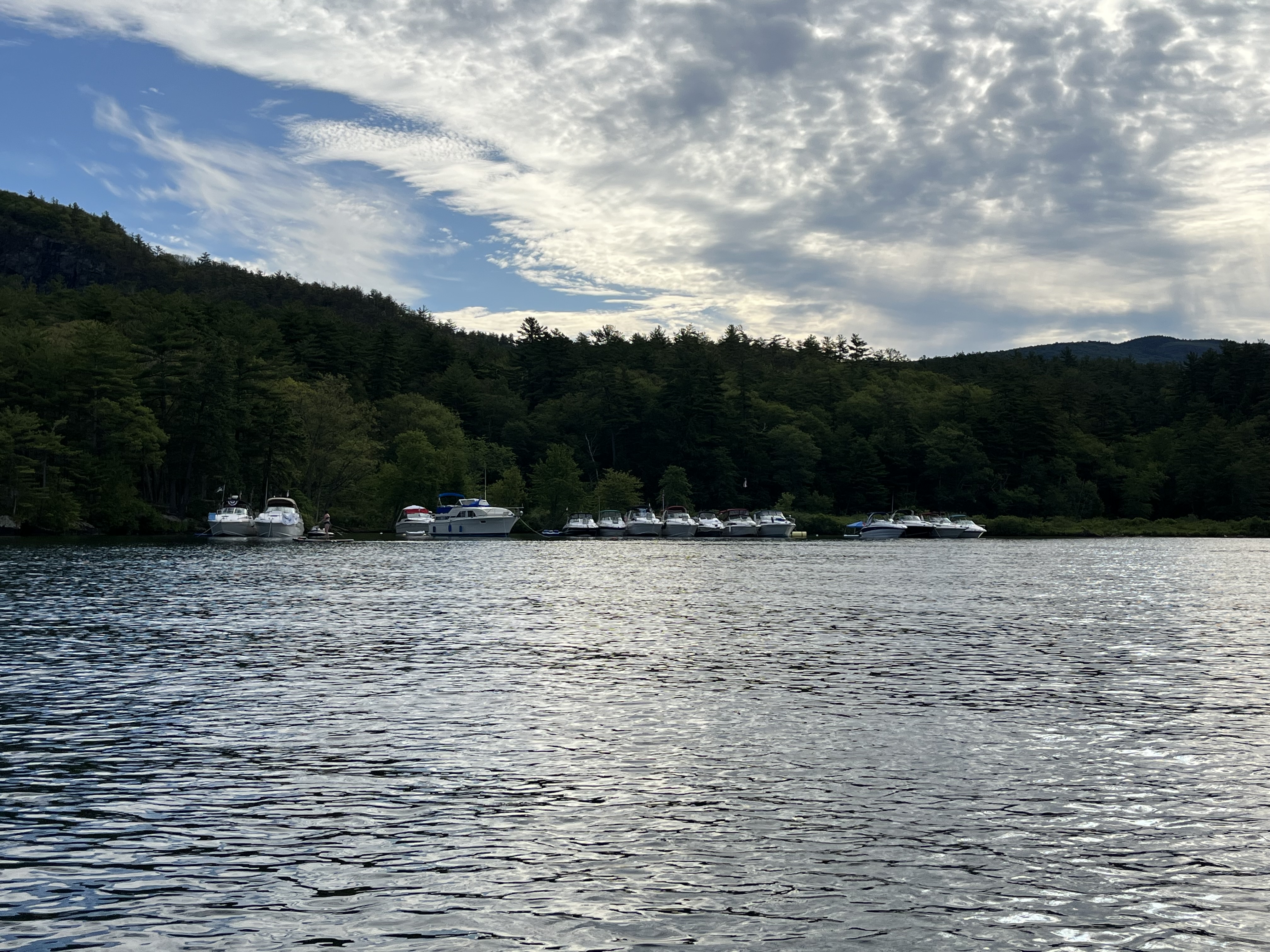
Anyway, on the way up to Glen Island I passed Log Bay and saw more than a dozen boats on the hook. It was pretty obvious that given the hour (well before 7AM) and their rafted positions, they had been there all night. 


I wondered if the Park Commission has changed the rules about boats dropping anchor and spending a night in a place like that. To my knowledge, Lake George traditionally has not been open to cruisers in that way; except for Red Rock Bay a bit to the north, I didn’t think that The Authorities would allow boats to spend the night at anchor without a permit at a designated island dock. Maybe I’m wrong and this is now permitted?


My worry, of course, is the obvious: are these folks equipped with the kinds of equipment for taking care of personal hygiene that will not impact the lake? Many years ago I heard Andy Rooney predict that “we’ll love this lake to death,” and when I see new concentrations and new high-impact uses like this, I worry a lot about the future.


Anyway, this morning I rowed a bit, I ate a big bite, and I wondered a bit more about the price a place pays for increased popularity. 


Tomorrow marks one week before I hit the road for the Finger Lakes. I’ll never be ready with training like this, but maybe I can treat the actual rowing as training and convince myself at end of the adventure that I can do it after I’ve done it?


That’s Crumb Cake Logic.


Love you guys!   


Saturday, July 2, 2022

Research

To get coached up on what I might look for and learn during my eleven-lake adventure, yesterday I had the great pleasure of sharing a cup of coffee with Chris Navitsky, the Lake George Waterkeeper. 


As you might imagine, Chris is one busy fellow, so having a chance to share a mug and learn about his work and the state of stewardship of the lake was a real privilege.  His long experience in effective advocacy while navigating the currents of science, the relentless press of economic development, the complexity of local and state politics, and vital collaboration with allied entities makes for interesting listening. As I listened to Chris I felt like an unprepared student attending a Master Class in Environmental Advocacy, but Chris- as great teachers do- brought me along in a way I could follow. 


Coffee poured and stirred, I asked Chris straightaway away about what I should be looking to learn during my row back to Lake George. With a wry smile and a hint of Zen, he started with, “Al, start by looking at what the lakes themselves tell you. They will talk to you, if you look closely.”


Chris went on to explain that the geology and geography and flora of the lakes is one thing, and are profoundly important, yet what I will see as evidence of human habitation as I row along the shore will be another. Does it look like the people who live there care about the sustained health of their waterway? Is there evidence of smart, responsible lakeside development that might protect a lake’s natural qualities? As I talk to folks along the way, what will I discover about their attitudes regarding zoning and planning and regulation? Will these functions be viewed as guardrails and guardians and sentinels or as impediments to “growth” or personal freedom? And as I ask old-timers about what they have seen in trends on their lakes or as benchmarks in their lives on the water, what will they say about the prospects of paying beauty forward?


I came away from my morning coffee with Chris recognizing that my most important asset on this trip may well be my ears, not my arms and shoulders. Each of these lakes will tell a story if I have the wit and patience to listen.


Speaking of aging arms and shoulders, I’ve been out on the water trying to awaken the rowing muscles, such as they are. I rowed 45 miles last week, a paltry 6.5 miles-per-day average, in preparation for a Finger Lakes trip that will demand 35 to 40 miles on some days and close to 400 miles in total. 


The muscles I am trying to awaken are hitting the snooze button and telling me to roll over; they’ll wake up on July 13th. 


I hope they will.


Finally, thank you, Fabulous Finger Lakes Folks, for your early expressions of interest and support in this adventure, such as it is. I’m certainly not the first person who’s done this, nor will I by any means be the “fastest,” or even the oldest. But I feel I can vie for the title of Most Appreciative for the opportunity, for your hospitality, and for being in place and a moment when I can even give it a try. As I follow the national news and lament the division and intractable polarization we continue to embrace, I can at least look forward to learning learn all I can about how we’re taking care of the blessing and beauty of our lakes. 


I hope that’s enough.


Mo’ latah!


Thursday, June 9, 2022

Community

They say that you get out of something what you put into it, and I think that that truism is largely true, but in the case of  Eleven Laps Around, I’m way, way out of balance at this point.

First, there’s the matter of the boat. Yesterday morning I drove up to Vermont to retrieve my Adirondack guide boat from its birthplace at (you guessed it) Adirondack Guide Boat in North Ferrisburgh.


 My hull was born in their shop sixteen years ago this summer, and Ian and Jason Martin and Steve Kaulback met me at the door with the justifiable pride and confidence that any accomplished pediatrician would meet a nervous papa collecting his teenager from the hospital. 


My high-mileage teenager needed some work. Not only did Jason and Ian tighten and tweak and patch with their typical super-craft, they also sent me off with some incredibly sexy feather-light spooned pine oars with the charge to “try them out.” 


Folks, believe me, the shape and weight oars have never been the limiting factor of my progress- I have only to look in the mirror to find that- but the prospect of seeing if these aquatic switchblades add a bit of efficiency to my stroke is exciting. 


If it wasn’t raining cats and dogs this morning and if I wasn’t shackled to this writing table by a cup ‘o Joe and a slab of rye toast, I’d be out there right now trying them out. I really would. 


So…my first thanks this morning go out to Ian, Jason, and Steve, plucky and kind entrepreneurs who build beautiful boats that enable old guys like me to keep going. (I’ll report back on the new oars, guys, but they’ll have to be revolutionary to persuade me to leave my cherry oars behind. Did the Lone Ranger swap out Trigger for an untested Palomino? Did Batman audition another athletic kid from New Jersey for the Robin role? Did captain Kirk turn to Scotty for his first counsel upon identifying the Klingons? I think not.) 


That’s Trigger on the left, the untested but promising Palomino on the right…..


My second heartfelt thank-you this morning goes out to the community along my route who have emerged to welcome me along the way. I haven’t rowed a stroke yet, but these Finger Lakes Folks are an extraordinary crew. In Homer’s Odyssey, a central tenet of that ancient time was the offering of unconditional hospitality to strangers as a kind of obligation. Wherever a seafarer came ashore, no questions were asked, no tribute was expected, no obligation was created. Wine was poured (the really good stuff, I think….not the swill I push off on family), lamb was roasted, soothing oils and robes were proffered…and security was absolute. Back then, it was the duty of the host to treat the supplicant with the care and attention due to even an honored guest, and a violation of this practice was an offense to the gods. 


Finger Lakes Folks must be avid readers of The Odyssey. 


No, I don’t expect goblets of wine and roasts and massage oil and warm flannel at the shoreline, but the 2022 version of The Odyssey is unfolding in front of me. 


Since the word got out about my intended route, people from Conesus (to the west) to Otisco (in the east) have stepped up to let me, a total stranger, know that I’m welcome to dine, camp out, or even shower at their place as I pass through. There’s a sense of a baton handoff building with me as the baton, and I’m really heartened that I’ll make some wonderful new friends in far-away places. 


I’ve encountered a lot of unconditional kindness through thousands of miles of rowing (and, sadly, a bit of rejection or downright hostility as well), but these Finger Lakes Folk are already a highlight of my trip. 


So if it’s true that we get out of something what we put into it, I’d better start ‘putting in’ pretty soon; I’m already receiving so much from communities of people who give out of kindness, empathy, and a generosity of spirit I’ll try to reciprocate! 


I’ll be on the water “training” tomorrow, finally….and investigating what those new pine planks have to offer. Then I’ll catch up on developments of the Lake George ProcellaCOR debate, start reading in earnest about the environmental organizations that my future hosts support and lead, and like Professor Harold Hill of The Music Man, apply ‘The Think Method’ to my preparation….


More later.


Thanks, all. What a crew I have with me. 


Thursday, May 26, 2022

Into the Light of Day

 May 24, 2022 

First Day at Lake George 


Today was filled with the kinds of chores that go with opening up a camp after winter: cleaning out the spaces just abandoned by the mice, working through a yard and garden that look lovely in nature but have to be recovered, making sure the water pump and hot water heater are ready to live in happy harmony, and wondering whether a repair here and there should be delegated to Flex Seal® tape instead of to my ham-handed craftsmanship.


Pulling my guide boat out of my neighbor’s small barn across the road was on my to-do list today if only to take stock of the repairs that I’ll need to attend to before I push off in July. I’ll trust Jason and Ian up at Adirondack Guide Boat to get at the structural stuff because to approach a boat of theirs with a roll of Flex Seal would be a felony, even if it worked.


Gentle Reader, I try not to pitch high and inside for commercial establishments in my blogs and I’ve never taken any sponsorship money, but I’ve GOT to tip my broad-brimmed hat to the folks up at Adirondack Guide Boat ( adirondack-guide-boat.com ) in North Ferrisburgh, Vermont. I’ve said it for fifteen years and over 4,000 miles of adventuring, and I’ll say it again: my guide boat enables me to take these trips. One can load it with gear, settle in with those beautiful nine-foot cherry oars, and sustain a good pace for hours on end through water and wind that might be otherwise troublesome. Guide boats were designed for hauling stuff, and their seaworthiness and efficiency make them a great choice for duffers like me. So before I get too far into this year’s adventure, I want to thank Ian and Jason for keeping me going. I hit things, I run over things, and I live a slovenly life while aboard, and once in a while my boat needs, shall we say, a tune up. 


Today’s barn find reminds me that I’m at that “once in a while” moment.  


So, Ian and Jason, thanks! You and your boats rock!


I’m a retired English teacher, and I see much of life these days through the lens of literature, much in the way I encouraged my students to experience the joys and travails of others’ lives through reading. Great books teach empathy. After two decades of working with young people, I’ve come to believe that empathy is the too-secret sauce of healthy relationships and responsible citizenship. 


Anyway, an English teacher might describe the recent developments in the proposed ProcellaCOR chemical situation at Lake George as the “rising action” of an increasingly troubling drama. For those of you following the story (and anyone interested in environmental stewardship in general and the challenges of working towards solutions in particular should be following this process), the Lake George Park Commission (LGPC) has been heading towards a test of ProcellaCOR, an herbicide proven to kill Eurasian milfoil, and the Lake George Association (LGA) has sued the LGPC and others to prevent the “test” until more lake-specific fact-finding can take place.  


In my last blog entry I wrote that “as truly excellent environmental organizations face off against the very authorities charged with the protection of the lake, I feel like I’m watching an argument between two best friends who agree on a Destination but differ in the all-important Route.” As I read and listen further, though, I’m not sure this situation is as simple and clear-cut as that. 


A sense of urgency around a timeline in ink has pressed the use of ProcellaCOR into the courts. The temperature of the debate is rising, and I would recommend the last two issues of the Lake George Mirror (5/13 and 5/20) as excellent reading for gathering insights on positions.  This is, indeed, “rising action” right here at home…


In a clear and compelling essay in the 5/13 issue of The Mirror, Jeff Killeen and Peter Menzies of the LGA offer the basis of the LGA’s objections to the impending use of ProcellaCOR. To the Mirror’s credit, a week later, on 5/20, Ken Parker and Dave Wick of the LGPC presented their position on the planned test along with significant context, and Anthony Hall’ typically excellent synopsis resides in a separate column. 


One would do well to read these articles back-to-back, along with Tony’s commentary, to gather foundational facts on the way to forming a responsible position. There’s a lot more to learn.


The background for ProcellaCor is compelling; it’s easy for a layperson like me to see it as a long-awaited silver bullet, one that has a track record elsewhere and advocates in high places. Yet it’s what we don’t know (yet) about its application in the lake - especially about the ramifications of even a successful test against milfoil- that concerns me. I myself hope that cool and collaborative heads prevail, taking the time necessary to answer what we don’t know (or to ask what has yet to be asked) while, at the same time, keeping the long term health of the lake as the paramount concern. 


On a more unified but no less important front, the LGPC is moving ahead with a focused and transparent process to establish basin-wide standards for septic system inspection, and this is uncontestable good news and vitally important. As faithful readers of this blog already know, my admiration for the folks at Keuka Lake is sky-high; their basin-wide commitment years ago to septic system monitoring literally saved their lake from dramatic decline (and saved their tourism, their property values, their health, and their sense of what it takes to do anything across many constituencies!). I hope that the Keuka Lake success story becomes a part of the Lake George public dialogue when this worthy initiative gets to that stage.


And, tomorrow, when I get in my boat for the first time this season, I hope I remember how to row.


More later….


Monday, May 16, 2022

Plastic

Our inland lakes have their troubles, that’s for sure: HAB’s, invasive species, wastewater and runoff management…the list is long and troubling, the problems relentless and complex. But yesterday I took a long walk on an isolated beach while here on a long-deferred trip, a stretch of golden Caribbean sand that faces the Atlantic and whose far shore is over 4,000 miles away. Looking up and away towards the horizon, nothing could have been lovelier: the azure sea breaks onto gently sloping beaches while pelicans and terns and the occasional frigate bird soar overhead like feathered sailplanes, hovering effortlessly in the on-shore breeze, checking out the buffet below.

I was first here fifty years ago as a college student tagging along on my girlfriend’s invitation to join her family on a sailing adventure. That girl is with me now, walking on this beach, saddened as I am about what we see half a century later. For rolling in the warm waters, undulating on the sand and basking at the high-tide line is a scourge of our time: plastic. As remote and as far-flung from activity as we are, the evidence of negligent prosperity is everywhere. I bend down to sift a handful of sand in my palm and feel a ridge of plastic, a “safety” ring of the kind that captures the cap of a bottle. Did it drift here from a cruise ship? From the Azores? From Europe? As we walk up to the high-water line, it is impossible to sift through a square meter of sand that does not carry some vestige of man. Our tailings are everywhere, broken down by abrasion and sun and time to almost granular sizes and stamp-sized shards. But it’s there, these plastic nodules, more dangerous to the environment and to animals in microscopic form than they were as bottles or intact rings. I’m told that the microscopic plastic residue is ingested by the “wild” fish that we eat and, once it’s in us, it’s come home, full circle. 


My impulse at the moment is to apologize to them, to the birds. 


I do. I’m sorry, I shout. We have spoiled our nest, and yours. It’s our doing, all of it. We’ve invented, produced, and even legislated our way to low- cost ultra-convenience. We’ve adopted our throw-away mentality as a habit, even as a right, oblivious to the fact that there is no “away” anymore. And the idea of a manufacturer being held fully accountable for the true life-cycle cost of its product would be laughable in Congress. If we can’t summon the resolve to control guns, for goodness sake, when will plastic show up on their to-do list? (Or, wait. If I looked into it, perhaps I’d find that we’re being more proactive about plastic than about guns as a public health issue?) 


It’s daunting to know that one is part of the problem simply by being a cooperative member of the species. My shouted apology to the birds is hollow, even hypocritical. The plastic in my life is ubiquitous even though I try to be mindful, environmentally responsible, and accountable. 


I’m ready to return home, back to inland lakes where “away” is as close as a neighbor’s shoreline and where our neglect, choices, and progress are more immediately apparent. The plastic and refuse I’ve seen on the beach today is distressing, especially since it has taken only 50 years to invent, manufacture, and fully distribute. 


There’s hope closer to home, I think, and models to show what is possible when we pull in the same direction. I’m grateful to the folks at Keuka Lake, for example, for the example of their shared resolve and action. In 2015, their eight municipalities rallied around the idea of the common good as they implemented a basin-wide policy to address septic and wastewater issues. It’s worked. I rowed their lake last summer and it was delightful, especially as I came to learn the story of their commitment and collaboration. Keuka Lake is an example of how the needs of a distressed eco-system can and must transcend political divides. It’s an idea that needs to arrive elsewhere, and everywhere, and soon.


Sorry about the rant, folks. But if you saw what I saw on the beach today, you’d be tappin’ the keys, too.


I’d better get on the water soon and start writing about a row, yes?      

Monday, May 9, 2022

 May 3, 2022

Baltimore

In seventy days I’ll start to row my Eleven Laps Around the Finger Lakes. My boat still rests in its winter quarters in the barn out back, my writer’s hands are soft, my arms feel like the jellyfish you see on the late-night ads for Prevagen, and my oars need a bit of varnish. But other than that, I’m rarin’ to go.

I’ve written about this before, namely the efficacy of mental preparation in lieu of physical exertion…me, sitting behind a keyboard with a cup ‘o Joe instead of flogging a rowing machine and lifting some weights. I could crow about how of late I’ve replaced the morning’s Apple Danish with a bowl of Grape Nuts, but you’d not be convinced that this is material progress. Neither am I.

But by mid-May I’ll be up at Lake George and will be able to “train” most mornings….as if rowing 2.2 miles up to Brian’s each morning for coffee and an Apple Danish (…oops. No, wait. Let’s make that a bowl of Grape Nuts) counts as training. But getting on the sliding seat and awakening the musculature, such as it is, will be a start. I’ll be ready.

Keen-eyed readers will note that my written-in-pencil plan has already changed by a couple of days. I’d like to time my lap around Keuka Lake with the weekend of the Antique Boat Show in Hammondsport (7/16). I was there last summer for the ultra- rainy day version, so I’m certain this will be a lovely weekend. Parenthetically, for those of you who have not visited either Hammondsport or the Finger Lakes Boat Museum https://www.flbm.org/, each is worth the trip. The Museum resides in the former Taylor Wine Cellar- an incredibly elegant site- and their collection ranges from fishing skiffs to Fay Bowens and everything in between.

Way cool, and wonderful people.

Right now my Lake World is abuzz with tension between those who plan to test Procella, an herbicide intended to eliminate Eurasian Milfoil on Lake George, and those who believe that the environmental impacts of Procella have not been sufficiently explored. It’s a tough but important debate. As truly excellent environmental organizations face off against the very authorities charged with the protection of the lake, I feel like I’m watching an argument between two best friends who agree on a Destination but differ in the all-important Route. There’s that old saw that says, “The best compromise is one where neither side is totally satisfied,” but the trouble with this one is that the next step is binary: the chemical is either going into the lake in a test, or it’s not. Right now, it seems like it will.  

I’ve got a lot of reading and listening and learning to do in this conversation because while milfoil is indeed a serious threat to the Lake, our hubris and urgency for quick fixes have gotten us into big trouble in the past. As a beloved business school professor once said in a class on Decision Analysis, “A decision not to make a decision is a decision.” My gut tells me that there would be no overt harm in holding off for now while conducting the research and testing sufficient to answer the questions on the table; the downsides of a too-hasty application are significant and the costs of deferring, for now, seem minor?

I read this article in the May 7th edition of the Orlando Sentinel; compared to our Lake George situation, it’s an apples-and-oranges situation, I think, but like so much of today’s news, you have to read it to believe it…..    


Ya’ gotta love the language here, right? “…a few thousand….trash fish…were impacted…” After all, what’s “a few thousand” when there are probably so many more? And….what’s the fuss about, anyway? After all, these are “trash” fish. And does “impacted” mean…ummm, like, they were killed?

I’m imagining that this is the kind of story that those urging great caution in the Procella debate fear could emerge if we run too quickly towards a solution to our milfoil problem. But then, this is Florida. It could never happen here, right?

Like I say, there’s lots of reading and learning still to do as this topic explodes in my own back yard. I expect that I’ll learn a lot more about environmental challenges and policy and advocacy during my row across a wide swath of New York.

Last summer, for example, I learned how the Keuka Lake Association and other environmental allies, along with every municipality surrounding this 22-mile gem of a lake, banded together to enact effective septic regulations that will protect and preserve their lake for the future. Their commitment to these regulations came from their hard-won experience that prevention is a lot more effective – and a lot less costly - than remediation after it all goes bad.

What a terrific model of collaborative commitment the Keuka Lake community presents for Lake George…and others! Rhetorical Question: What will it take for the Lake George basin to act as the ecological entity that it is rather than as the political patchwork that we have made it? Keuka discovered that Harmful Algae Blooms (HAB’s) are better prevented at the source(s) then combatted at the shoreline. I worry that unless and until we adopt the best practices of our neighbors, we’ll have to live through the tragedy of environmental degradation before we get to the work of remediation and recovery, even if that will be possible. What a shame.

Whew. Enough for now. Gotta’ get back to training for the row. This is about a row, remember? J